

The Aube Disposal Facility for LILW-SL (CSA)
Located in the municipalities of Soulaines-Dhuys, Ville-aux-Bois and Épothémont, in the Aube department, the Aube Disposal Facility (CSA) is dedicated to the disposal of Low- and Intermediate-Level Short-Lived Waste (LILW-SL)*. Commissioned in 1992, it succeeded the Manche Disposal Facility.
The CSA is a Basic Nuclear Installation (BNI No. 149), a licensed nuclear facility, operated by Andra. Covering a total area of 95 hectares, including 30 hectares dedicated to disposal activities, the facility is authorised to receive up to 1 million m³ of radioactive waste packages. At the end of 2025, 39.6% of this authorised disposal capacity had been used.
LILW-SL mainly consists of small items contaminated during the operation and maintenance of French nuclear facilities, such as gloves, protective clothing and tools. It also originates from research laboratories, hospitals, universities, as well as clean-up and dismantling operations.
Waste is packaged in concrete or metallic waste packages (drums, boxes and containers) before being disposed of in reinforced concrete disposal structures at the CSA.
As of 31 December 2025, more than 90 employees worked at the CSA, alongside more than 110 contractors working on site.
* Short-lived waste contains radionuclides with a half-life of 31 years or less. After this period, half of the initial radioactivity has decayed.
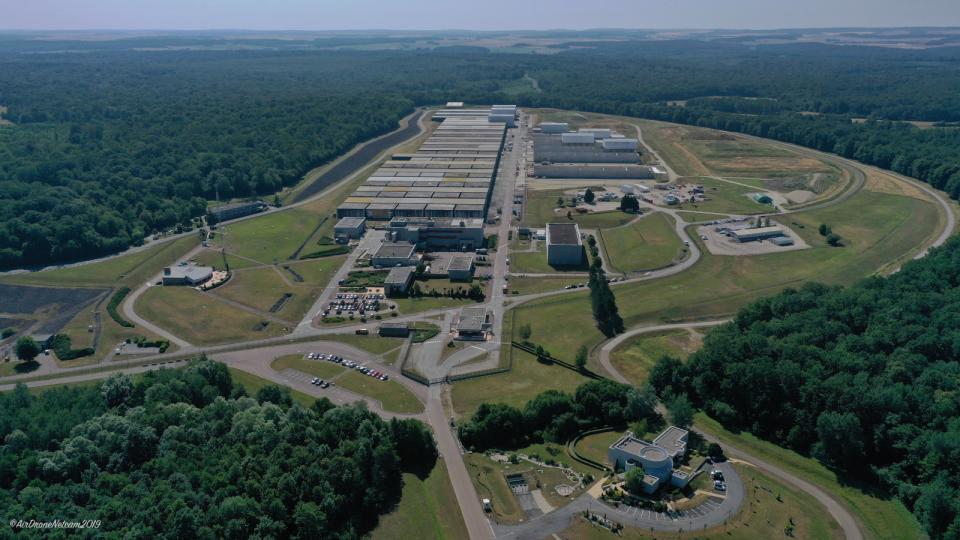
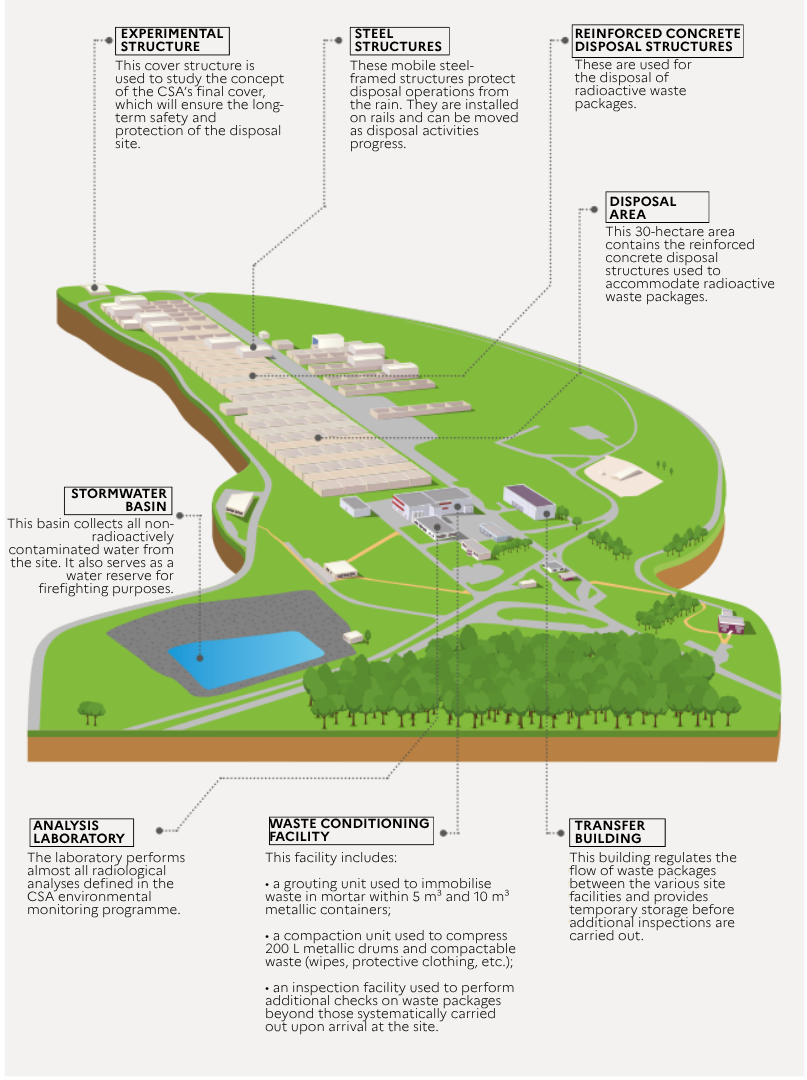
CSA Facilities
The CSA combines waste reception, conditioning, disposal and monitoring activities within a single industrial site dedicated to the long-term management of LILW-SL.
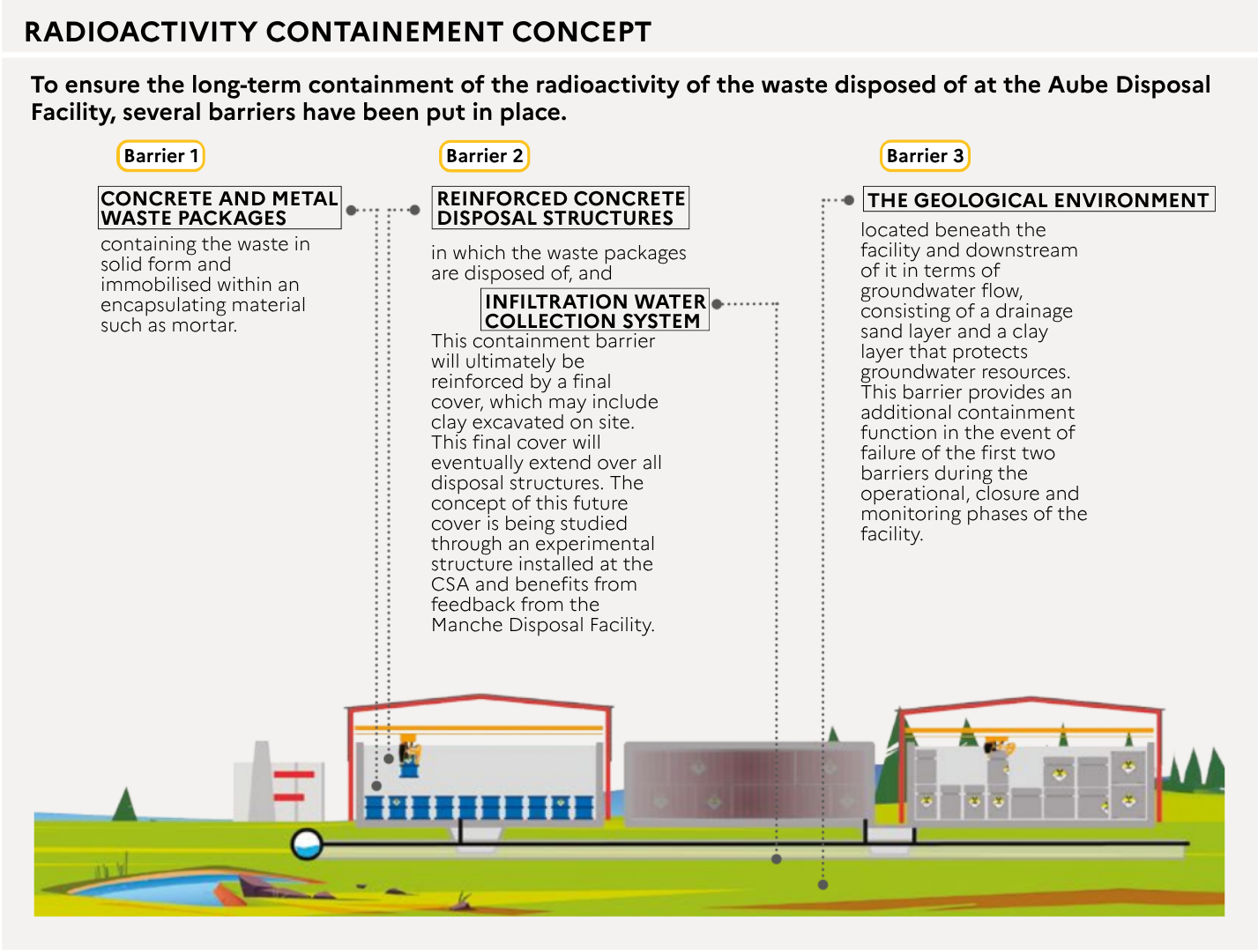
Safety at the CSA
The long-term safety of the CSA is based on a series of engineered and natural barriers designed to contain radioactivity and protect people and the environment.
LILW-SL packages treatment
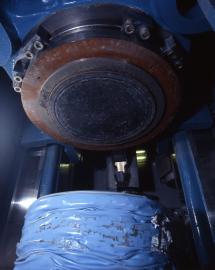
To optimise disposal capacity, the CSA operates a compaction press that reduces the volume of compactable waste, such as plastics and gloves, initially packaged in 205-litre drums.
The compacted discs produced by this process are then placed in new 450-litre containers and immobilised with mortar.
The facility also operates a grouting unit used to inject mortar into 5 m³ and 10 m³ metallic containers holding bulky waste.
Disposal of LILW-SL Packages
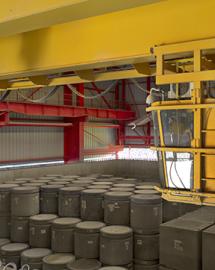
Radioactive waste packages are disposed of in reinforced concrete structures measuring 25 metres by 25 metres and approximately 8 metres high. Disposal operations are carried out under a mobile steel-framed structure that protects activities from weather conditions.
Two types of disposal structures are used:
- Concrete-grouted structures, designed for metallic waste packages. The packages are emplaced in successive layers, with a layer of concrete poured after each level;
- Gravel-filled structures, designed for concrete waste packages. These packages are stacked until the structure is full. Gravel is then placed between the packages to ensure their stability within the structure.
Once filled, the disposal structures are closed with a reinforced concrete slab. The watertightness of the facility is ensured by an impermeable coating applied to the external walls of the structures. In the long term, the disposal structures will be protected by a final cover, consisting notably of clay and other engineered materials designed to ensure long-term protection of the disposal facility.