

Why Deep Geological Disposal?
High-level waste (HLW) and intermediate-level long-lived waste (ILW-LL) remain hazardous for very long periods of time. Managing these waste categories therefore requires a solution capable of ensuring the long-term protection of people and the environment, even over timescales far exceeding those usually considered in industrial projects.
Waste repository concept
Deep geological disposal is based on the principle of isolating radioactive waste deep underground within a carefully selected geological formation and protecting it through a combination of engineered and natural barriers. This approach aims to ensure long-term safety without relying on active human intervention over the very long term.
Today, deep geological disposal is widely recognised internationally as the reference solution for the long-term management of the most hazardous radioactive waste.
A Solution Designed for Very Long Timescales
The objective of geological disposal is to isolate radioactive waste from people and the environment for as long as it remains hazardous.
Unlike near-surface disposal facilities, deep geological repositories are located several hundred metres underground in stable geological formations. At such depths, the waste is protected from surface phenomena such as erosion, climate change, human activities and other natural processes that may affect the surface environment over very long periods of time.
Once all waste packages have been emplaced, the disposal facility is progressively closed, allowing the geological environment to play its role as a long-term natural barrier.
The Geological Disposal Concept
In Cigéo, radioactive waste is intended to be disposed of in dedicated underground disposal cells excavated approximately 500 metres below ground level.
The disposal system relies on a combination of engineered components and the surrounding geological formation. Waste packages are placed in disposal cells specifically designed according to the characteristics of the waste they receive.
Over time, the radioactivity contained in the waste gradually decreases through radioactive decay. At the same time, the geological environment contributes to limiting the movement of radioactive substances and ensuring their long-term confinement.
The objective is to provide passive long-term safety, ensuring protection even in the absence of future human intervention.
Multiple Barriers for Long-Term Protection
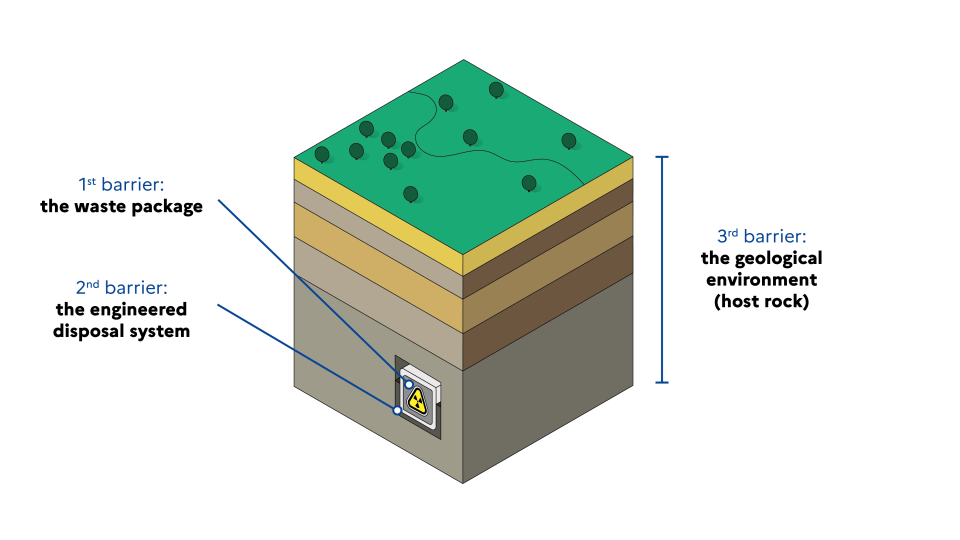
The safety of geological disposal relies on several complementary barriers working together over time.
The first barrier is the waste package itself. High-level waste, for example, is immobilised within a durable glass matrix and contained within robust metallic packages.
The second barrier consists of the engineered structures of the disposal facility, including disposal cells and closure components designed to contribute to long-term containment.
The third barrier is the host rock itself. The geological formation surrounding the repository provides natural confinement properties that significantly limit the migration of radioactive substances.
Together, these barriers provide a robust and redundant system designed to protect people and the environment over very long timescales.
Why the Callovo-Oxfordian Clay Formation?
The Cigéo project is based on the Callovo-Oxfordian clay formation located in eastern France.
This clay layer was deposited approximately 160 million years ago and has remained remarkably stable over geological timescales. It is characterised by very low permeability, which greatly limits water circulation, and by strong retention properties that help slow and restrict the movement of radioactive substances.
The formation is also sufficiently thick and homogeneous to accommodate a deep geological repository while contributing to its long-term safety.
More than thirty years of scientific investigations, including studies conducted in the Underground Research Laboratory in Meuse/Haute-Marne, have contributed to the detailed understanding of this geological environment and its suitability for geological disposal.
An Internationally Recognised Solution
Deep geological disposal is being developed or implemented by radioactive waste management organisations around the world as a long-term solution for high-level and long-lived radioactive waste.
While national programmes differ in their technical approaches, geological environments and implementation schedules, they share the same objective: ensuring the long-term protection of people and the environment through the isolation and confinement of radioactive waste in suitable geological formations.
The development of Cigéo benefits from decades of international scientific cooperation and exchanges with organisations facing similar challenges worldwide.