

Preserving knowledge across generations: radioactive waste management in international dialogue
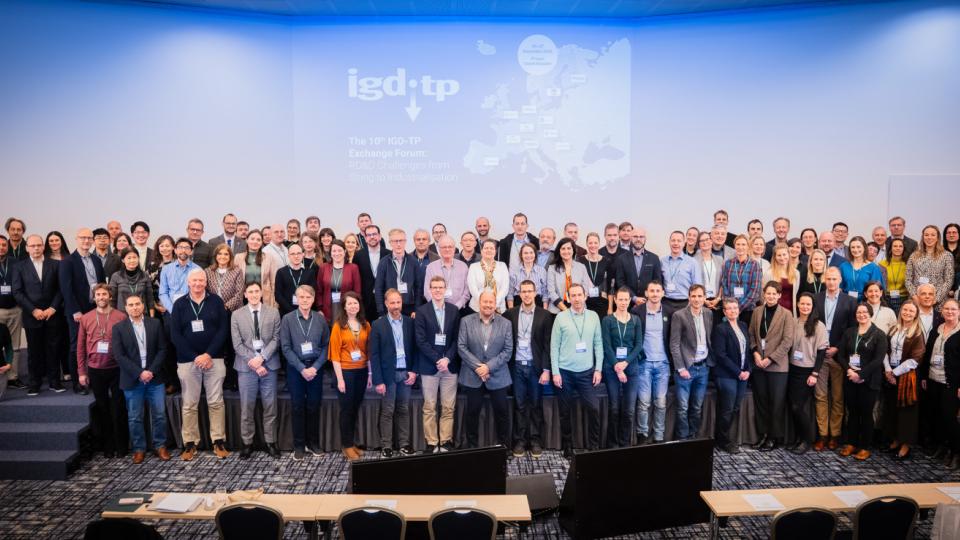
In autumn 2025, the international Information, Data and Knowledge Management (IDKM) platform held its first symposium in Yokohama, Japan. Bringing together practitioners, managers and researchers from across the world, the event offered a unique opportunity to compare national approaches to knowledge and memory in radioactive waste management and to share recent progress.
Managing radioactive waste raises questions unlike any other. The materials involved may remain hazardous for periods far exceeding the lifespan of our societies, our institutions and even our cultures. How can information about disposal facilities be preserved and made meaningful over such timescales? How can future societies, whose languages, symbols and ways of life are unknown to us, be made aware of sites created in the distant past?
Beyond these long-term considerations, knowledge transmission is also a very concrete challenge for today’s waste management organisations. Nuclear facilities operate over several decades, and deep geological repositories such as France’s Cigéo project are designed to function for more than a century. Ensuring continuity of knowledge over such durations is essential for safety, governance and public trust.
It was to address these issues that the OECD Nuclear Energy Agency (NEA) launched the IDKM initiative in 2020, providing a dedicated international framework for research and exchange on information, data and knowledge management in radioactive waste management.
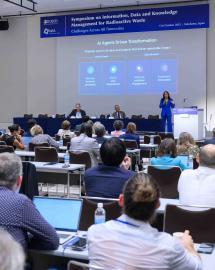
Five years on, the Yokohama symposium marked a major milestone. Participants reviewed the work of IDKM’s three expert groups: one focused on data and information management for safety cases (EGSSC), another on knowledge management for radioactive waste management programmes and decommissioning (EGKM), and a third dedicated to archiving and awareness preservation (EGAAP). The discussions were also deliberately opened to perspectives beyond the nuclear field, with contributions from the European Space Agency and from Cornelius Holtorf, a Swedish archaeologist of the future, whose work explores how societies communicate meaning across deep time.
Preventing the loss of critical knowledge
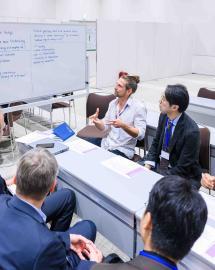
“The level of interest in these questions is clearly increasing,” notes Vincent Maugis, Head of Knowledge Management at Andra and a member of the symposium’s scientific committee. “This symposium has attracted not technical experts, but also senior managers and executives engaging with these topics... It is all very new.”
What is the reason behind this sudden change? Vincent Maugis answers: “The first disposal facilities were developed thirty years ago. The “pioneers” of the field are now retiring, and there is therefore a risk of knowledge loss, which calls for a specific organisational framework to safeguard and transmit knowledge throughout the entire lifecycle of the facilities.”
Andra contributed actively to the symposium through presentations by Camille Arrignon, Knowledge Manager, and Florence Poidevin, Head of the Memory for Future Generations programme. Their work prompted strong interest among participants. “Practices differ widely from one country to another,” says Vincent Maugis, “which is precisely what gives this cooperation its richness. Andra’s main strength undoubtedly lies in its approach, which is among the most comprehensive and integrative.”
Memory as an ethical responsibility
For Andra, the issue goes beyond technical management. It is also an ethical one. While some countries initially explored strategies based on deliberate forgetting, Andra chose from the outset to recognise a responsibility towards future generations: knowledge of the past should not be intentionally withheld.
This conviction led to the creation of Andra’s Memory programme in 2011, structured around four complementary pillars: regulatory documentation and archives, social interaction, research and studies, and international cooperation. “Exchanging on our practices, within the IDKM expert groups or at events such as this symposium, is highly relevant in our field,” explains Florence Poidevin. “Transmitting memory to future generations is, in a way, like addressing strangers whose language and symbolism we do not know. Comparing our approach with that of the Japanese, for example, whose culture is very different from our own, is a valuable exercise.”
Symbols that carry memory forward : Fukushima's cherry trees
Preserving memory is not only a matter of records and archives. It also relies on narratives, symbols and shared experiences. This perspective is central to Andra’s approach and resonates strongly in Japan, where civil society plays an active role in keeping memory alive.
One of the most powerful moments of the symposium was a visit to Fukushima. “The visit to Fukushima, on the fourth day of the symposium, was one of the most striking moments,” recalls Florence Poidevin, “It highlights how quickly nature reclaims its place, erasing the traces of the accident. The cherry trees on the site, which are a source of pride for its workers, echo the initiative of a local resident who decided to plant 20,000 more, both to preserve the memory of the event and, symbolically, to move forward…”
In time, these trees may help ensure that the story of what happened here continues to be told, passed down from one generation to the next, long after the event itself has faded into history.